





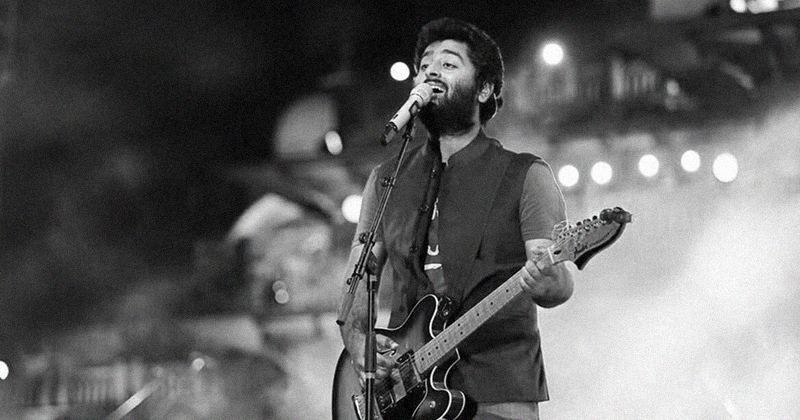
Arijit Singh has announced that he will no longer take on new playback singing assignments, marking a significant moment for the Hindi film music ecosystem.
In a statement shared on social media on Tuesday, Singh said he has decided to step away from playback work, even as he remains one of the most commercially dominant voices in Indian cinema.
“Hello, Happy New Year to all. I want to thank you all for giving me so much love all these years as listeners. I am happy to announce that I am not going to be taking any new assignments as a playback vocalist from now on. I am calling it off. It was a wonderful journey,” Singh wrote.
The 38-year-old clarified that he is not exiting music entirely. He will continue to release independent material and complete existing commitments.
“God has been really kind to me. I am a fan of good music and in future will be learning more and do more on my own as a small little artist. I still have to finish some pending commitments, which I will. You might get some releases this year. Just to be clear, I won’t stop making music,” he added.
Singh did not elaborate on the reasons behind his decision. From an industry perspective, however, the move reflects structural changes already underway in the Hindi film music business.
Singh’s decision comes at a time when film playback is no longer the primary engine of scale or leverage for top-tier artists. The traditional model, built on high-volume recording across films and languages, offers limited control and long-term upside relative to the value generated by marquee voices.
Streaming has altered that equation. Artists of Singh’s stature now operate with direct audience relationships, global reach and sustained consumption independent of film release cycles. In July last year, Singh became the most followed artist globally on Spotify, surpassing Taylor Swift and Ed Sheeran, with over 151 million followers.
At that level of platform dominance, playback work increasingly represents output volume rather than strategic growth. Stepping away from new assignments allows greater control over pacing, creative direction and career longevity, all of which are constrained within mainstream film production timelines.
The decision also has implications for the broader film music ecosystem. Playback singing has long relied on a concentrated pool of voices servicing a large share of releases. As leading artists recalibrate their participation, labels and composers may be forced to broaden talent pipelines and rethink dependence on a handful of bankable voices.
Importantly, Singh has not ruled out music creation, only new playback commitments. That distinction underlines a wider shift in artist priorities, where films are no longer the default centre of musical relevance.
Singh rose to prominence after appearing on Fame Gurukul in 2005, made his playback debut with “Phir Mohabbat” (Murder 2, 2011), and broke through with “Tum Hi Ho” from Aashiqui 2 in 2013. Over the following decade, he became one of Hindi cinema’s most consistent hitmakers, recording across genres, stars and languages, and earning multiple Filmfare Awards.
What makes this moment notable is the timing. Singh’s decision suggests that even at peak demand, the traditional playback model may no longer align with how top artists assess value, control and sustainability in a streaming-led music economy.


