

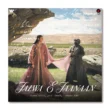


For the fourth track of its fourth season, Coke Studio Bharat turns its attention to Kashmir with Hoor, a song that draws from the region’s oral storytelling traditions while bringing together a live ensemble of more than 40 musicians.
At first listen, it is easy to focus on its sweeping arrangement, the interplay between folk influences and rock instrumentation, or its closing passage in Kashmiri. But beneath the production lies a more fundamental creative decision: Hoor was never conceived as a conventional song.
Speaking to Music Plus, singer-songwriter Faheem Abdullah, alongside composer-singers Arsalan Nizami and Ustad Qaiser Nizami, reflected on the writing, arranging and recording process behind the track, explaining why the music had to follow the logic of a story rather than the conventions of a radio single.
Letting the story shape the music

For Faheem Abdullah, the starting point wasn’t a melody or a hook. It was the storytelling tradition itself.
“The storytelling is what drew me to Hoor before anything else did,” he says. “It comes out of Afsana Goyi, a tradition that has existed in Kashmir for generations: stories carried through music, passed mehfil to mehfil, voice to voice, never fixed on paper.“
That immediately ruled out a conventional songwriting structure.
Instead of compressing the narrative into a familiar verse-chorus format, the trio allowed the composition to move between spoken narration and melody, mirroring the rhythm of a traditional mehfil where stories unfold gradually, pause naturally and return to song when the moment calls for it.
“A fable like Sheikh and Hoor’s doesn’t move that way,” Faheem explains. “It breathes. It pauses. It lets narration speak for a while before handing things back to melody.“
The decision extended beyond structure. Ending the song in Kashmiri, he says, was never intended as a stylistic flourish.
“That is the language the story actually lives in. Coke Studio Bharat gave us room to do that properly instead of translating it into something safer. The whole task was trusting the old shape instead of sanding it down to fit somewhere else.“
Why Hoor could only be recorded live
The decision to record Hoor live was equally inseparable from its origins.
Rather than treating live recording as a production choice, Faheem describes it as something embedded in the concept from the beginning.
“With something built out of mehfil culture, live was already inside the first idea,” he says. “A mehfil doesn’t exist on a click track. It exists because a room full of people are actually listening to each other and responding in real time.“
That philosophy fundamentally changed how the music was prepared.
Instead of building a record layer by layer through overdubs, the focus shifted towards creating an environment where musicians could respond to one another organically.
“I had to stop thinking like someone assembling layers and start thinking like someone setting up a room,” he explains. “Not writing parts for people to overdub later, but writing space for people to actually meet each other inside.“
Recreating the dynamics of a mehfil
Capturing the atmosphere of a mehfil meant far more than placing every musician in the same studio.
According to the trio, the essence lies in the interaction between performers rather than the physical setup itself.
“It isn’t only the sound,” Faheem says. “It’s the room holding its breath for what happens next. That comes from musicians genuinely watching each other, listening to each other, not simply hitting their part on cue.“
That philosophy informed the recording process throughout.
Instead of aiming for perfect synchronisation, the musicians embraced genuine musical conversations, allowing performers to react instinctively to one another.
“Someone leading, someone else arriving a half-beat behind because they’re truly reacting, not because it was charted that way beforehand,” he explains.
For the team, preserving that responsiveness became essential, particularly as the production expanded in scale.
“That intimacy disappears quickly the moment a song moves to a bigger stage, and keeping it from getting produced away was really the whole point.“
Writing for more than 40 musicians
Large ensemble recordings often invite bigger arrangements. For Hoor, however, scale wasn’t simply about adding more instruments. It changed the way the music itself was written.
“When you know that many musicians will be in the room together, you start reaching for texture and depth you simply can’t access when you’re building a song piece by piece on your own,” says Faheem.
He points to moments where the entire ensemble seems to breathe together, as well as layered vocal passages created by people singing in the same space rather than through multiple studio takes.
“You can’t manufacture that with plugins. You either have that many real people in front of you or you don’t.“
Knowing the full ensemble would be recording together also influenced the arrangements from the outset.
“Having them changes what you even reach for when you sit down to arrange, because you’re no longer limited to what one or two players can physically produce.“
Keeping the story at the centre
With more than 40 musicians contributing to the recording, avoiding excess became one of the project’s defining creative disciplines.
“The arrangement is there to serve the story, not the other way around,” Faheem says.
He admits the temptation to continuously expand the arrangement was always present, but returning to the principles of a mehfil helped guide every decision.
“Not everyone plays at once. Not everyone is loud at once. There’s narration, there’s space, there’s restraint and then there’s a moment where everything opens up because the story has actually earned it by then.“
For him, the emotional arc of Sheikh and Hoor remained the organising principle throughout.
“The scale exists to serve that, so the peaks land with the weight they need to, not so the song can demonstrate how many people were in the room that day.“
Carrying a story forward
For Faheem, interpreting a story rooted in Afsana Goyi was never about reproducing every word exactly as it had been told before.
Instead, the responsibility lay in preserving something less tangible.
“The feeling, more than anything,” he says.
“A story that has survived this long hasn’t survived because of its exact wording. The words shift a little each time someone tells it. What survives is the atmosphere, the emotion, the sense that you’re being told something in the moment by someone who means it.“
That gave the trio the freedom to build an entirely contemporary sonic landscape around an older tradition without feeling constrained by literal replication.
“I built a rock soundscape underneath something centuries old,” he says. “But if I lose that sense of being told a story rather than performed at, then I’ve failed the tradition regardless of how technically faithful everything else is.“
The moments you can’t script
Recording live inevitably produces moments that no amount of planning can recreate.
For Faheem, those unscripted interactions ultimately justify the entire process.
“The moments you can’t plan for tend to be the most honest ones on the record,” he says.
Whether it’s a musical phrase answered instinctively by another performer or an unexpected texture emerging from dozens of musicians responding simultaneously, those moments were deliberately preserved.
“When something like that happens, you don’t smooth it out afterward. You keep it, because it’s the evidence that the mehfil actually took place rather than being reconstructed later to resemble one.“
Looking beyond Hoor
While Hoor may introduce many listeners to Kashmiri music for the first time, Faheem hopes it becomes a starting point rather than a destination.
He points to the region’s rich musical landscape, from Sufiana Kalam to traditions built around instruments such as the santoor and rabab, as well as generations of musicians and storytellers whose work has continued long before streaming platforms brought wider attention to regional music.
“Hoor is one door into a house with many rooms,” he says.
“Kashmir didn’t just surround me growing up. It raised me. And there is far more of it than fits into a single track, however much I love this one.“
With Hoor, Coke Studio Bharat has delivered more than another regional collaboration. It is a record shaped by decisions that consistently favoured process over convenience: allowing an oral tradition to dictate song structure, recording a large ensemble live, resisting overproduction and trusting musicians to respond to one another in real time. The result is a track that feels rooted not because it recreates the past, but because it allows the principles of that tradition to shape how the music is made.