



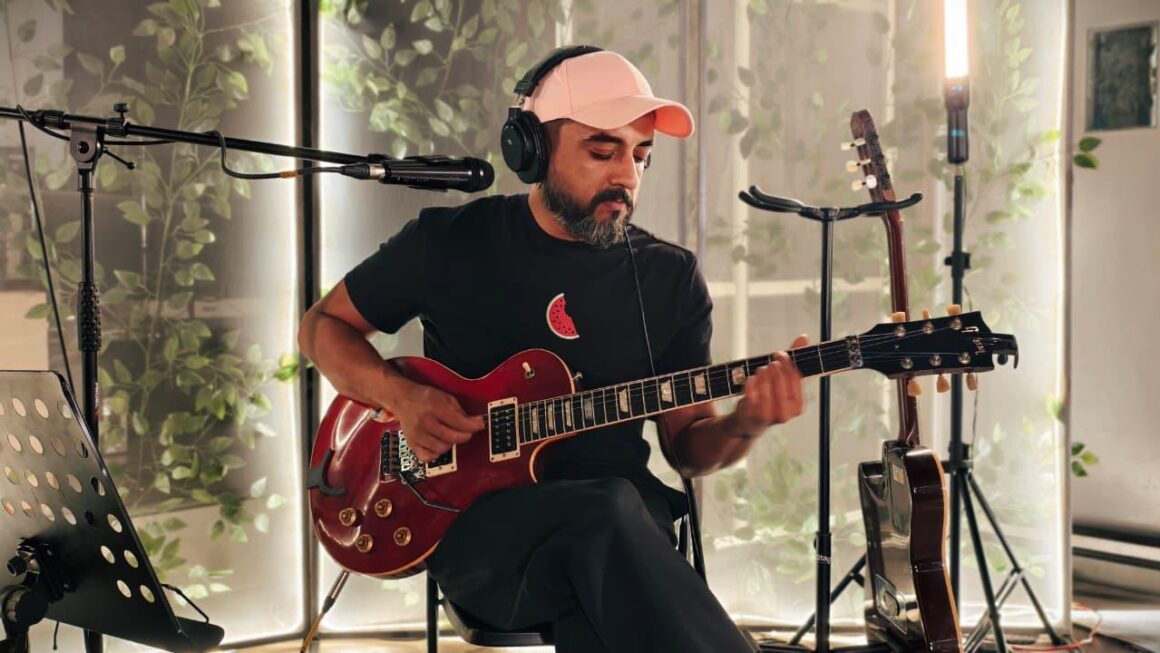
A health scare changed Sanjeev T’s relationship with music. Five years later, an eight-track instrumental album, recorded live with fellow musicians over four days, marks a shift in how he approaches the process of making it.
For years, guitarist and composer Sanjeev T’s work revolved around music. Then a health scare changed that relationship. He lost the motivation to create, particularly in a studio, and began questioning his identity beyond being an artist and musician.
The way back wasn’t through a new sound or a more disciplined studio routine. It came through playing live, jamming with friends and spending time with musicians who reminded him why he wanted to make music in the first place.
Touring with Sid Sriram helped him reconnect with that feeling. So did the realisation that he was most creatively engaged when he wasn’t working towards a particular outcome.
That experience eventually led to Comfortably Dumb, an eight-track instrumental album built around live performances and collaboration. Recorded over four days, the record takes shape through ideas exchanged before the sessions and others developed spontaneously in the room.
For Sanjeev, the process was as important as the finished album. “It was being real, with no expectations, that led me to this record,” he says. “Not being afraid to make mistakes, and not being afraid to let go of expectations.”
Letting the music take shape
Two of the album’s eight tracks were fully composed before recording, with Sanjeev sharing guitar ideas through voice notes. Four others began as short musical sketches sent to the band. The final two came together during the sessions themselves.
One of those was the album’s closing track, featuring Sid Sriram. His involvement wasn’t part of the original plan. Sanjeev had invited him to join the musicians for a jam, and the session eventually produced a new composition.
That openness was central to the recording process. Rather than building each track through layers of recording, editing and production, the musicians played together in the same room. Their individual influences shaped the arrangements, with each take offering the possibility of a different outcome.
Sanjeev has recorded a live album before, so he was familiar with the demands of the format. But Comfortably Dumb pushed the idea further, with some compositions still taking shape as the musicians played.
“Every mistake and imperfection became part of the expression and opened up new creative possibilities,” he says.
The approach also challenged the assumption that a record needs months of production to reach completion. With musicians comfortable in a live setting and a team that understood the process, the album took just four days to record.
For Sanjeev, working this way wasn’t about rejecting studio production altogether. It was about finding the right conditions for the music to develop without overworking it.
The difference between making content and making music
The album’s recording process also reflects Sanjeev’s unease with the growing pressure to make music that meets external expectations. He sees a distinction between creating content to fit industry trends and making art as a form of personal expression.
“Content follows the rules of social trends, stimulating consumption and industry etiquette,” he says. “Art is a moment in time when creation comes forth to stimulate something from within a human being.”
The distinction becomes particularly relevant in a music industry where artists are expected to balance their creative work with visibility, audience growth and a steady flow of content. These pressures aren’t limited to how music is marketed. They can also influence how artists judge their own work.
Sanjeev believes that the industry’s pursuit of perfection can come at the cost of curiosity. More numbers, greater polish and an increasingly narrow idea of what works can leave musicians with less room to experiment.
His response on Comfortably Dumb was to allow the music to remain imperfect where it needed to be. The album captures the performances as they happened, rather than attempting to eliminate every deviation from an ideal take.
That approach also informs his view of artificial intelligence. He draws a distinction between using technology as a creative tool and relying on it to execute a task. As AI-generated content becomes more sophisticated, he believes imperfection could become more valuable precisely because machines are getting better at reproducing perfection.
“AI will always strive for perfection, and it’s only going to get better at being perfect,” he says. “And maybe that is exactly why imperfection is going to become even more valuable.”
The people behind the music
Having worked with artists such as A.R. Rahman and Sid Sriram, Sanjeev has experienced different approaches to collaboration. Working on another artist’s project requires him to adapt his playing and sensibilities to the music, while leading his own project gives him greater control over its direction.
But the freedom he wanted for Comfortably Dumb wasn’t limited to his own performance. He wanted the musicians around him to have the space to bring their own identities into the record.
That requires more than technical ability. For Sanjeev, the character of the people he works with has become increasingly important.
“Talent and work ethic matter,” he says. “But being a person who can accept people despite where they come from or what they believe in is something I value deeply.”
It’s an approach that extends to his work as a teacher. Young musicians today have access to more music, technology and learning resources than previous generations could have imagined. But that access comes with pressure to build a profile, create content and demonstrate progress constantly.
Sanjeev worries that musicians can become preoccupied with establishing themselves before they’ve had enough time to develop their own voices.
“Music takes time. Curiosity takes time. Finding your own voice definitely takes time,” he says.
He tells his students that learning an instrument isn’t simply about how many songs they can play. It’s about discovering what they have to say through it.
A different measure of progress
The experience of making Comfortably Dumb has changed what Sanjeev expects from his own work. Earlier in his career, he might have been more concerned with how a piece of music sounded. Now, he’s equally interested in how it felt to create it.
That doesn’t mean the music itself matters less. Rather, the process no longer has to serve as proof of his ability as a musician.
“The biggest thing this album gave me was the understanding that I don’t have to control everything,” he says. “I can start with an idea, bring the right people into a room and allow the music to take its own journey.”
For an industry increasingly shaped by metrics, production tools and the pressure to remain visible, that is a useful counterpoint. The value of a recording need not be measured only by its polish, its reach or how efficiently it was made. The experience of making it can matter, too.
For Sanjeev, Comfortably Dumb represents a return to that understanding. “I wasn’t trying to be a better musician. I was just trying to be a more honest one,” he says.
After a period in which music had become difficult to engage with, that shift may be the album’s most significant outcome.